Neuropsych
Neuropsych is a browser-based cognitive assessment platform built around research-backed tests, deterministic scoring, and evidence-grounded cognitive profile reports.
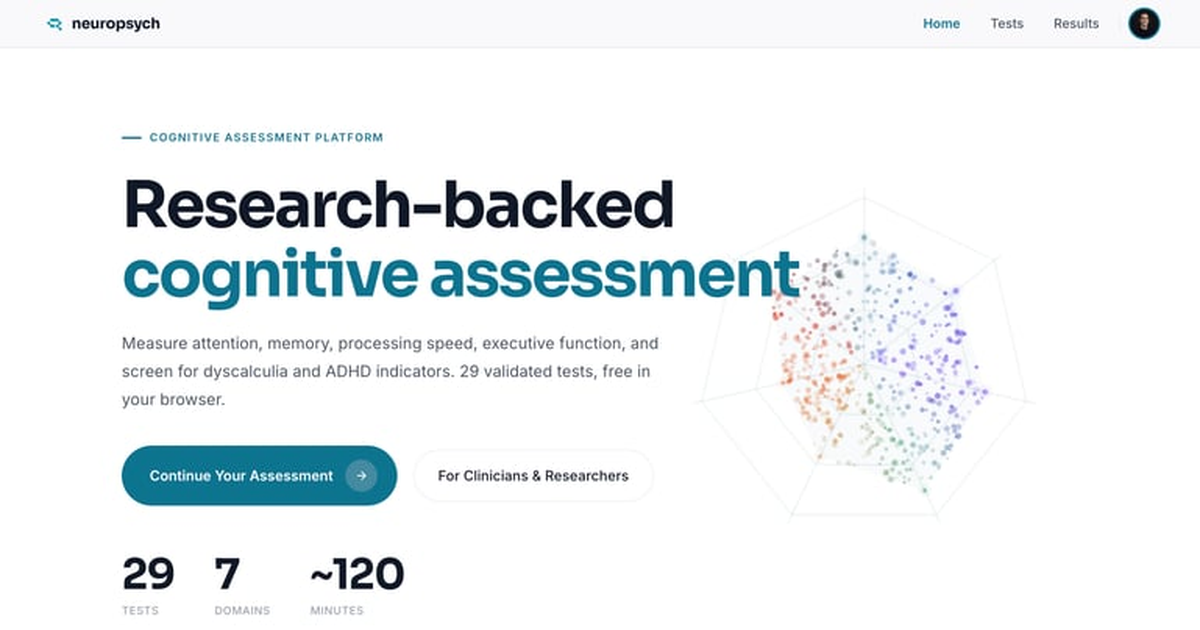
- StatusLive site / active platform
- RoleBuilder, product designer, system architect
- DomainCognitive tests, profiles, ADHD and dyscalculia screening paths
- Core ideaTests in browser, deterministic scores, evidence-grounded reports
Why it exists
Neuropsych came from a practical question: how much of a serious cognitive assessment experience can be made accessible on the open web, without turning the product into a black-box quiz or a clinical overclaim?
The platform gives people a structured way to explore cognitive domains like processing speed, working memory, executive function, attention, and dyscalculia-related skills.
It is designed as a research-backed assessment and reporting platform, not a diagnosis engine. The useful promise is clearer cognitive self-understanding, with visible methods and evidence.
What I built
Neuropsych combines a large browser-based test battery, bilingual test flows, deterministic scoring, normative tables where available, academic retrieval, and AI-generated reports grounded in source material.
-
29 cognitive tests
The platform covers seven domains through standardized task paradigms implemented in jsPsych, with English and Spanish assessment flows.
-
Deterministic scoring
Raw results are converted through explicit scoring logic into z-scores, percentiles, standard scores, and raw-only labels when norms are not ready.
-
Norms and methods
Reports use population norms where available, including Spanish adult norms from NEURONORMA for selected tests.
-
Evidence-grounded reports
The report engine combines academic retrieval, clearly labeled community context, LLM synthesis, and PDF rendering into a cognitive profile report.
Decisions that mattered
Math stays deterministic. The AI layer does not score the tests. It explains patterns after explicit scoring has already produced the numbers.
Validation status stays visible. The platform is clinically informed and research-backed, but formal validation is still a future study path. That distinction matters.
Methods are part of the product. The battery is organized around cognitive domains and published paradigms, with methodology pages and citations available on the live site.
Personal sensitivity shapes the UX. ADHD, dyscalculia, and cognitive profiles are emotionally loaded topics. The interface needs to feel clear, careful, and nonjudgmental.
Neuropsych treats AI as a reporting layer around a real assessment system, not as the source of the scores themselves.
Neuropsych is built on a simple boundary: tests and scores should be computed, reports can be synthesized, and users should always be able to inspect the difference.
Why it holds up
Neuropsych holds the line between measurement and interpretation. The tests produce explicit scores; the reporting layer explains patterns after the assessment work has already happened.
That boundary matters for trust. A cognitive profile can be useful only if the product is clear about what is measured, what is inferred, and what still needs validation.