LivingLab
LivingLab connects a character-led public site, generated web assets, Atlas-driven publishing, and a printed QR token that lands people on mobile.
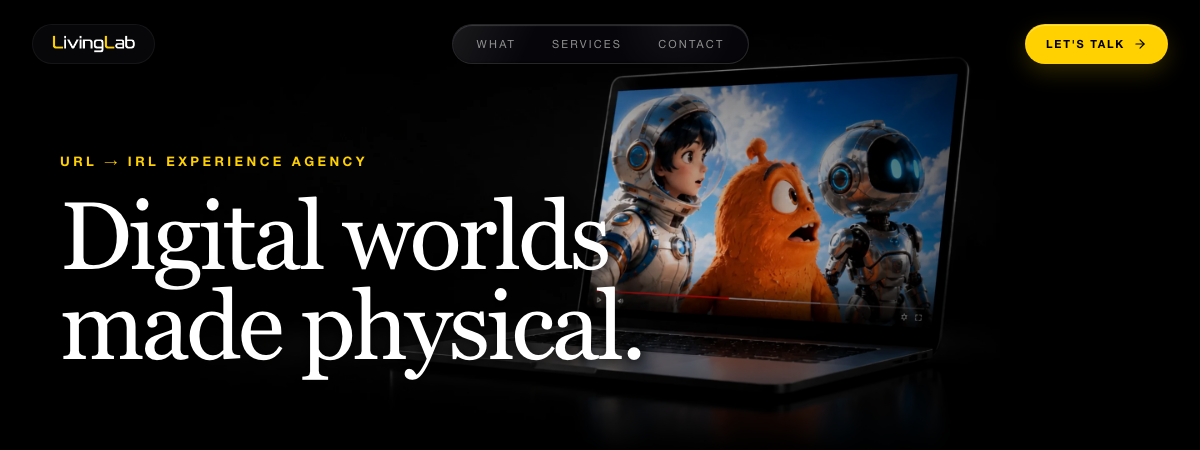
- StatusLive site / signup and character surface
- RoleWeb design, character workflow, Atlas integration, publishing
- StackOpenClaw agents, Higgsfield refs, Codex, Cloudflare Pages/API
- Physical loop42mm printed QR token to mobile landing
Build focus
This page focuses on the build surface: how the public web design, character generation, deployment flow, and physical token system came together.
The useful pattern is digital IP made inspectable. The website gives the idea a public face, the characters give it memory, and the token turns the page into an object someone can hold, scan, and revisit from a phone.
What I built
The shipped surface combines a cinematic black-background website, character-driven interaction, signup capture, first-party analytics, Cloudflare Pages deployment, and a token prototype that treats the landing page as part of a physical experience.
-
Character-led web design
The public site uses the astronaut, orange character, and chrome robot as recognizable anchors instead of generic AI backgrounds.
-
Reference-preserving generation
New character assets are generated from approved references, with identity checks for proportions, materials, facial features, and role continuity.
-
Atlas publishing loop
An OpenClaw agent can assemble the asset context, use Higgsfield for generation, then hand Codex the selected output for direct Cloudflare deployment.
-
Physical-to-mobile bridge
The 3D printed token uses a real first-layer QR geometry and a mobile landing page as the next step after a physical handoff.
Decisions that mattered
References before prompts. The character pipeline does not rely on description-only generation. The accepted workflow starts from approved reference files and rejects outputs that drift.
Agents as production operators. Atlas is not just writing copy. The system can coordinate generation, source tracking, asset placement, Git/Codex edits, and Cloudflare API publishing as one operational loop.
Mobile is part of the object. The token is designed around a scan path, not as a static souvenir. The QR side, print geometry, and landing page are one experience.
Deployment details are product details. The public site moved through Cloudflare Pages, custom domains, first-party analytics, signup routing, and cache-safe asset versioning.
LivingLab connects AI systems to physical workflow infrastructure: character identity, website iteration, deployment, and object-to-web continuity.
Scan path as physical interface.
Interactive Token VisualizerThe token concept is a small printed object with raised LivingLab identity on one face and real QR geometry on the other. The scan opens a mobile landing page, turning a handoff into a measurable entry point.
- Diameter42 mm coin-sized token
- Height3.5 mm max with raised art
- QR37 modules / 0.92 mm modules
- RoutePhysical scan to mobile landing
LivingLab turns the website into a staging area: characters are generated and tested there, Atlas can publish into it, and physical tokens can point people back into it.
Why it holds up
LivingLab shows the connective tissue between creative direction and implementation: visual systems, character continuity, agent orchestration, deployment discipline, and physical interface thinking.
The strongest part is the operational loop: a character system can move from references to generated assets to a published page to a scannable physical object without losing the thread between identity, context, and destination.