Council
Council is a financial intelligence system built around a simple constraint: every answer has to trace back to the data, source, rule, or calculation that produced it.
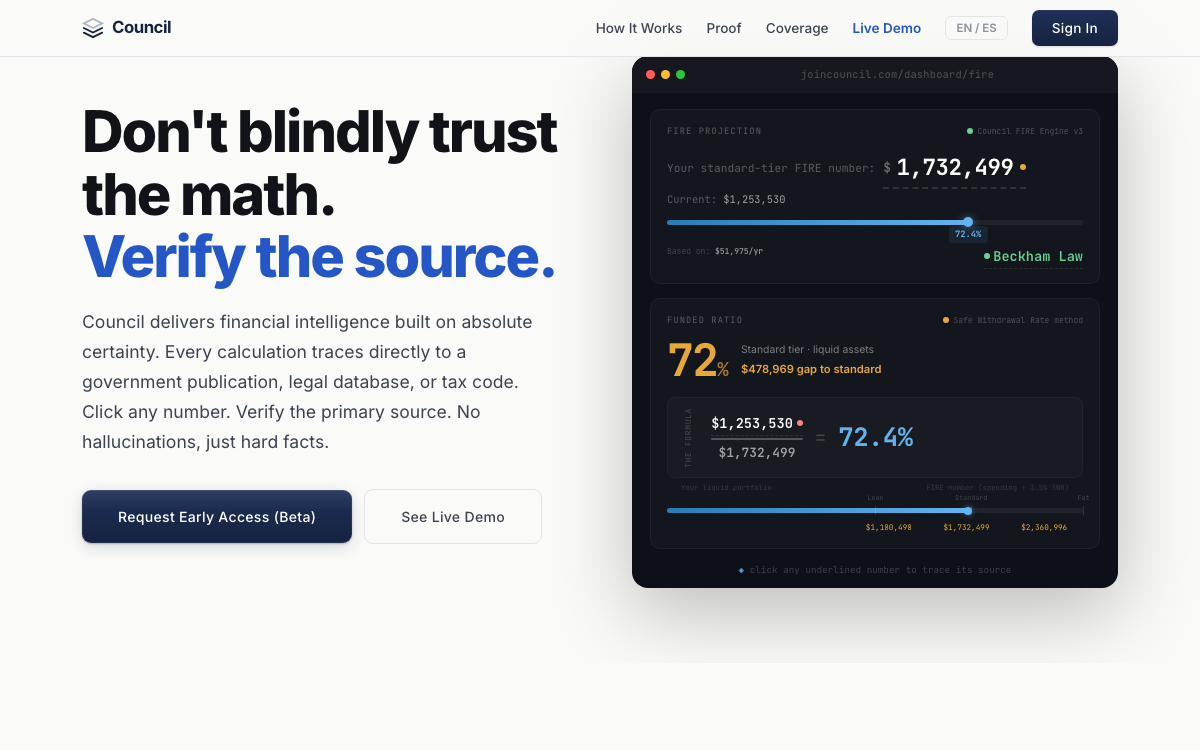
- StatusLive site / active build
- RoleBuilder, product designer, system architect
- DomainFinancial planning, taxes, portfolio logic, relocation
- Core ideaAI interface, deterministic math, auditable sources
Why it exists
Most personal-finance tools are either calculators without context or chatbots without provenance. They can produce a number, but they rarely show why that number is true.
I built Council for decisions where that is not good enough: FIRE planning, cross-border tax questions, RSU timing, relocation timelines, portfolio assumptions, and the kind of personal constraints that change the answer.
The product thesis is that financial AI should feel conversational at the surface, but behave like an auditable system underneath.
What I built
Council combines a product interface, structured financial profile, deterministic calculation engines, and curated knowledge packs. The user can ask questions naturally, but the system is designed to keep the answer tied to sources and assumptions.
-
Financial profile
Accounts, income, portfolio structure, tax regime, location, dates, and personal assumptions are treated as structured inputs, not just chat context.
-
Calculation engines
Core outputs come from explicit planning logic: FIRE projections, tax treatment, funded ratio, cash timing, and scenario comparisons.
-
Source chain
Claims and assumptions trace back to primary sources, legal references, knowledge packs, or user-provided records.
-
Product surface
The public site shows the product direction: verified financial intelligence where every number can be clicked, challenged, and inspected.
Decisions that mattered
Provenance before persuasion. The design is not trying to make a financial answer sound confident. It is trying to make the answer inspectable.
Deterministic math under an AI layer. The AI can help route, explain, and summarize, but the important numbers should come from explicit code paths and known assumptions.
Personal context is part of the model. A generic retirement calculator cannot answer the same questions as a system that understands relocation timing, foreign tax regimes, RSUs, cash buffers, and actual accounts.
The product site stays product-first. Council links back to me as the builder, but the page itself stays focused on the user problem.
Council is designed around a simple boundary: conversational answers are only useful when the numbers, sources, and assumptions can be inspected.
Council is less a chatbot than a discipline: if the system cannot explain where a number came from, the number is not finished.
Why it holds up
Council works because the interface is only the top layer. The stronger product is the structure underneath: explicit assumptions, deterministic calculations, source chains, and a user experience that makes financial confidence inspectable.
The point is not to make AI sound more certain. It is to make the planning system honest enough that a person can challenge the answer and see what changes.